Whether you call them Key Opinion Leaders (KOLs) or Key External Experts (KEEs), success in the pharmaceutical space has always started with one essential task: identifying the right experts to engage, influence, and collaborate with. These are the clinicians who publish groundbreaking research, present at major conferences, and serve on advisory boards that help shape the future of their therapeutic areas. Traditional KOL identification has long been the gold standard—and for good reason. But today, the healthcare conversation extends far beyond medical journals, conference stages, and advisory board meetings. It’s happening in LinkedIn discussions, on X, in YouTube educational videos, and in online communities where clinicians share perspectives, challenge interpretations, and debate emerging data in real time. If your brand is still looking for influence through traditional methods alone, you may be overlooking some of the most relevant voices shaping clinical perspectives today.
KOLs vs. DOLs: What’s the Difference?
Traditional KOL identification is grounded in established indicators of expertise and credibility: clinical reputation, publication history, institutional affiliations, speaking engagements, and peer recognition built over years, sometimes decades, within the medical community.

Digital Opinion Leaders (DOLs) build influence differently. Their authority emerges through the content they create, the conversations they spark, and the professional communities they engage online. They may or may not possess the traditional credentials of a KOL, but they demonstrate influence through their digital reach, engagement, and ability to shape conversations around a therapeutic area.
The two may overlap, but the distinction is important: traditional KOL identification focuses on who an expert is. DOL measurement reveals how they influence conversations, where that influence occurs, and whom they reach.
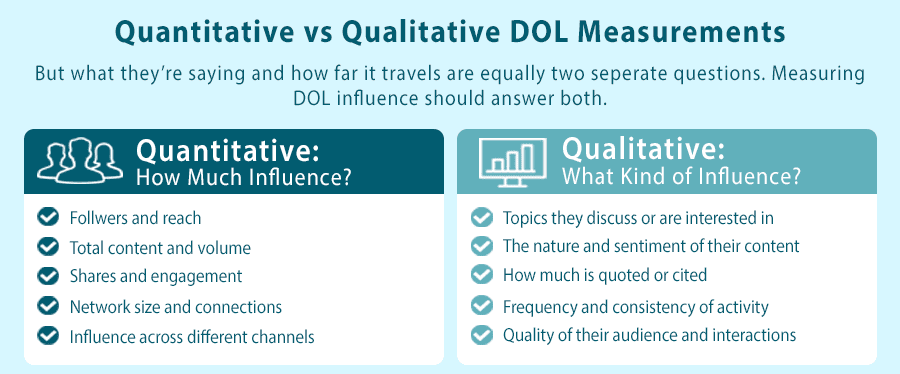
Qualitative vs Quantitative DOL Measurements
But “what they’re saying” and “how far it travels” are really two separate questions. Measuring DOL influence should answer both.
The first is a question of substance: is this person saying something worth listening to?
The second is a question of scale: how many people are actually hearing it, and how far does it spread?
A DOL strategy that answers only one of these questions gets only half the picture. That’s why DOL measurement is typically broken into two distinct categories, qualitative and quantitative, each capturing a different dimension of influence.
Qualitative measurements assess the nature and quality of a DOL’s influence, not just how loud they are. This is where you evaluate whether someone is actually shaping the conversation or just participating in it.
Quantitative measurements are the objective, countable indicators of digital activity and reach: the numbers behind the name.
Putting It Together
Neither column tells the full story on its own. A DOL with enormous reach but little credibility isn’t necessarily moving opinion. A DOL with sharp, highly credible content but a small, static following may not yet have the scale to matter to your brand. The real signal is in the combination: who has both the substance and the reach to actually shift how a therapeutic area is discussed.

What We Found When We Looked for Ourselves
This isn’t just a theoretical framework for us. In a recent KOL and DOL study we conducted for a client, the side-by-side comparison ranked a list of Digital Opinion Leaders in a therapeutic category and that same client’s existing KOL identification list.
The result was telling: the individual ranked #1 among DOLs, by both qualitative and quantitative measures, didn’t appear anywhere in the KOL list. Not as a top prospect. Not on the radar at all.
Across the full comparison, more than 40% of the identified DOLs had no match in the existing KOL list whatsoever. Several of the most qualitatively influential voices, individuals actively shaping sentiment and conversation in the space, were completely invisible to a search process built around traditional KOL criteria.
In other words: if you’re only searching for KOLs, you may be missing some of the most influential people in your therapeutic category entirely, including the single most influential one.
Why This Matters for Your Brand
The traditional KOL and the modern DOL aren’t competing categories, they’re complementary ones. Not all influence is created equal. Brands that rely exclusively on legacy identification methods risk building engagement strategies, advisory boards, and speaker programs around an incomplete picture of who actually matters in their space. Brands that incorporate DOL measurement alongside traditional KOL identification get the fuller picture, and the opportunity to engage the voices who are shaping opinion right now, not just the ones who shaped it a decade ago.
At V2V, we built our DOL and KOL comparison methodology precisely because we kept seeing this gap. The digital landscape has created a new frontier of influence in pharma, and finding the right experts means knowing where, and how, to look for all of them.
The V2V Advantage: Connecting Both Dimensions of Influence
The distinction isn’t about choosing one over the other. It’s about aligning expert identification with the desired outcome. By evaluating traditional credentials alongside digital activity and engagement, V2V helps brands develop a more complete view of the experts influencing a therapeutic area—and make more informed decisions about whom to engage, where, and why.
✓ Deeper insights
✓ broader perspective ✓ more informed decisions ✓ greater impact
To learn more about how V2V can help you identify and engage both traditional and digital opinion leaders in your therapeutic area, please complete the form below.
Contact Us
"*" indicates required fields