Let’s be honest— most people don’t go into pharmaceutical marketing because they’re passionate about compliance paperwork. But here’s the thing: speaker programs are still one of your most powerful channels for engaging and educating healthcare professionals, and the government is paying closer attention than ever before.
That heightened scrutiny stems largely from legislation that changed how these programs are monitored and reported. The Physician Payments Sunshine Act was born in 2010 as a federal law requiring drug and device manufacturers to publicly report certain payments and other transfers of value to physicians and teaching hospitals. Three years later, in 2013, the Centers for Medicare & Medicaid Services (CMS) enacted the Open Payments program to collect and publish this data, making the law’s requirements transparent to the public.
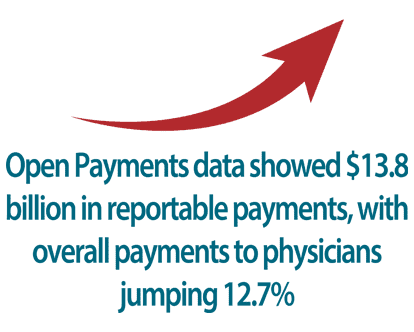
Over the past decade, Open Payments has evolved into a program marked by stricter oversight and heightened enforcement of accurate, Sunshine Act–compliant reporting. Last year, Open Payments data showed $13.18 billion in reportable payments, with overall payments to physicians jumping 12.7%. CMS noticed that spike, too. They’re now using advanced analytics and AI to flag anything that looks unusual, and manufacturers of drugs, devices, biologicals, or medical supplies can get randomly selected for a CMS audit at any time.
What Has Changed
Here’s what we know so far. CMS updated their Open Payments FAQs in 2024, and they’ve ramped up audits—which are expected to continue. Companies are getting flagged for audits based on risk criteria like prior noncompliance, atypical data patterns, and unusual reporting.
The penalties? They can hit $1 million, and that number goes up with inflation each year. In the event of an audit, you’ll need to be able to produce detailed records including receipts, contracts, training logs, and standard operating procedures.
The good news is that you can stay on top of CMS Open Payments changes by proactively addressing these three key considerations:
1. Build a Compliant Foundation
Compliance is often won or lost before your speaker takes the stage. Your pre-event planning should include rigorous documentation protocols that can withstand scrutiny.
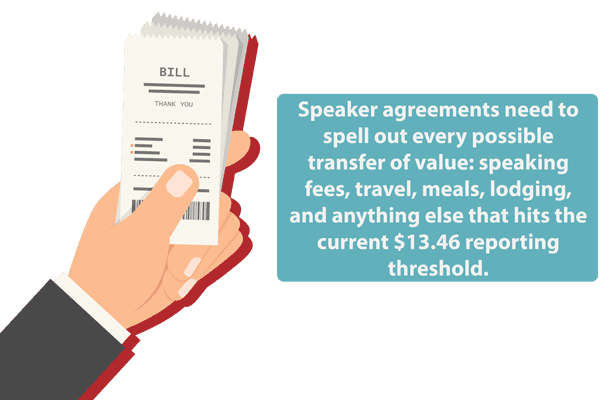
You need systems that pull together all your healthcare professional (HCP) reporting data across every department. Every touchpoint—from that first email to the final payment—needs a clear audit trail. Your contract management must be bulletproof. Speaker agreements need to spell out every possible transfer of value: speaking fees, travel, meals, lodging, and anything else that hits the current $13.46 reporting threshold provided by CMS for the calendar year 2025 (unless the aggregate amount to the “covered recipient” exceeds $134.54). These threshold amounts are expected to increase each year.
2. Select the Right Speakers for the Right Reasons
In our experience, your speaker selection process should demonstrate clear criteria based on clinical expertise, publication history, and therapeutic area relevance. This isn’t just good business practice; it’s audit defense. When CMS asks why Dr. Smith got $30,000 in fees this year, you need documentation for every reportable payment.
That said, you should consider conducting regular internal reviews of your speaker roster to determine the experts who truly add value to the healthcare conversation. The bureau you had last year might not meet today’s standards, especially as bureaus continue to evolve with the rise of digital opinion leaders. Right-sizing your speaker’s bureau isn’t just about efficiency—it can also impact compliance.
3. Ensure Post-Event Reconciliation is Airtight
Post-event reconciliation ensures every dollar spent is properly categorized and reported. More than ever, as you reconcile actual expenses against budgeted amounts, it’s important to document last-minute changes in travel arrangements or any unexpected costs that may arise. You should have processes in place for speakers who need replacement at short notice, ensuring substitutions don’t create reporting gaps.
Also, keep detailed records of everything and monitor your own reporting patterns proactively. If your food and beverage expenses spike one quarter, you’ll want to know why before CMS asks.
Why This Matters More Than Ever

The medical education compliance landscape isn’t just evolving—it’s accelerating. What we’re seeing in 2025 may be just the beginning of much tighter enforcement of Sunshine Act compliance. Companies that get ahead of this won’t just avoid penalties. They’ll demonstrate the kind of operational excellence, transparency, and integrity that builds trust with regulators, speakers, and the broader HCP community.
The question isn’t when the rules might change—it’s whether you’ll be ready when they do.
By proactively evolving your speaker programs, you can do more than survive the new enforcement reality. They can build stronger programs with better documentation and clearer processes, as well as better identify speakers who add the most value to your bureau. Because that’s what peer-to-peer education is really about connecting the right experts with your HCP customers to improve patient care. Everything else—including compliance—should support that mission, not complicate it.
The Vision2Voice Advantage

Compliance with the latest Open Payments reporting requirements is made easier through trusted partnerships with experts who understand both the regulatory climate and the strategic imperatives of peer-to-peer education. When you work with Vision2Voice (V2V) as your MedComm partner, you gain the structure, systems, and strategic oversight needed to meet your business requirements.
Our approach ensures seamless integration across all facets of speaker’s bureau management—from initial expert identification through post-event reconciliation.
Contact us today to learn how V2V can help keep your MedComm initiatives strategically effective and in 2025 and beyond.